Products / CX line / CX-09
CX-09 Starter Sol Eclipse D 5-70TK
Summary
Compare in the guideCX-09 Starter Sol Eclipse D5-70TK is best viewed as a ambitious but competitively limited release. While it offers a high degree of customization and experimentation, its real-world performance falls short of making it a must-have for competitive players. It delivers its greatest value as a tool for experimentation and learning, particularly for new players interested in exploring customization.
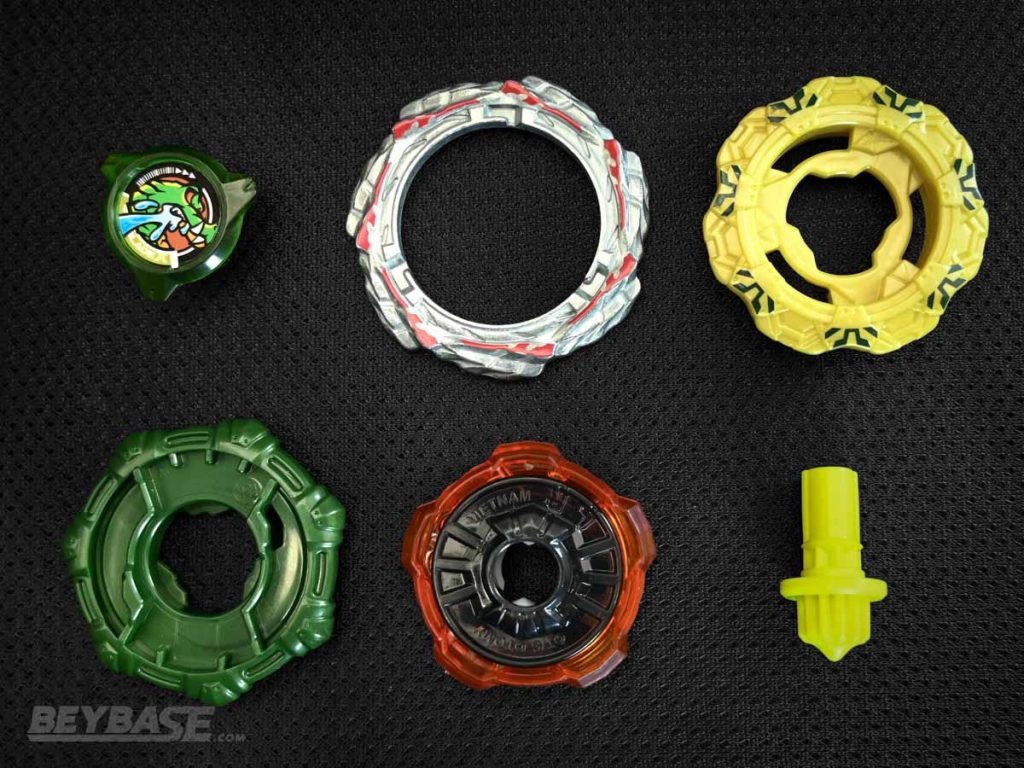
It is a right-spinning balance type Custom Line (CX) Beyblade X top that comes with four brand new parts to the series: the Sol Lock Chip, Eclipse Main Blade, Dual Assist Blade, and Trans Kick Bit. The Sol Eclipse Blade features a motif and design inspired by Sol Blaze V145AS from the Metal Fight Beyblade series. As a Starter, it also includes a Long Winder and Winder Launcher.
The Eclipse Main Blade, Dual Assist Blade, and Trans Kick Bit all feature mode-changing capabilities, enabling a total of eight unique configurations of the stock Beyblade. This makes it one of the most versatile releases in the CX line, allowing players to experiment with upper-focused and smash-focused orientations, as well as mid-battle height variation through the Bit.
However, this versatility does not fully translate into competitive effectiveness. While each mode offers subtle differences in contact points and behaviour, most configurations lack the specialization needed to consistently compete with more optimized parts. The overall design places it in an awkward middle ground; capable of doing many things, but not excelling in any one area.
Strengths
- The Eclipse Main Blade and Dual Assist Blade form the core identity of this release, introducing a system of fully reversible parts that allows players to switch between upper-focused and smash-focused contact points. In theory, this gives the Beyblade access to a wide range of matchups: upper modes can lift opponents and create knock-out opportunities, while smash modes aim for more direct, forceful hits. This flexibility is further enhanced by the Trans Kick Bit, which adds height variation mid-battle, creating subtle shifts in contact timing and angle.
- The concept of eight total configurations is the biggest selling point here. Compared to most CX releases, Sol Eclipse offers significantly more room for experimentation within a single product. This makes it particularly appealing for players who enjoy testing matchups, adapting to opponents, or exploring niche configurations without needing a large parts collection. This layered customization makes this product a budget-friendly introduction to the world of Beyblade for players who are interested in diving deeper into how they can affect performance through customization.
- The Eclipse Main Blade itself is five-sided, relatively thick and heavy, and is fairly well-balanced. “Double Upper Mode” features pronounced upward facing slopes leading upwards to a wavy top side. The flatter bottom side allows it to line up cleanly with Assist Blades attached below it. This mode allows it to pair well with thick Assist Blades such as the Wheel Assist Blade in defense type customizations. On the literal flip-side, “Double Smash Mode” shifts the more aggressive side down below. It creates a gap between the Assist Blade and Main Blade and exposes the more aggressively-shaped side to opponents below. When playing against combinations of a shorter height than it in this mode, a downward smash effect can be produced, which at times can knock opponents off-balance. Lock Chips also tend to sit slightly lower in Eclipse than they do on other Blades, lowering their centre of gravity slightly.
- The Dual Assist Blade has a five-sided design relatively thick design. It complements the Eclipse Main Blade with a similar mode-changing gimmick of its own. The “Upper Mode” and “Smash Mode” orientations allows players to adjust the direction of its contact points. Upper Mode features a more rounded design with slopes facing inwards. Smash Mode exposes blunt contact points on the opposite end of those slopes, enhancing the attack power of customizations that use it.
- The 5-70 Ratchet provides a stable, middle-height platform that complements the Beyblade’s it is attached to. Its five-sided structure offers relatively even weight distribution and decent burst resistance compared to more aggressive or lower-profile Ratchets. This makes it a serviceable option for general use.
Weaknesses
- Despite its theoretical versatility, Sol Eclipse D 5-70TK struggles with consistency and identity. Each individual mode tends to feel like a weaker version of a specialized alternative. A key issue is that the mode differences, while noticeable, are not dramatic enough to fundamentally change its competitive viability. In practice, many of the eight configurations end up performing similarly, reducing the real-world impact of the gimmick.
- The Eclipse Main Blade suffers from a design which tries to do everything, but ends up doing close to nothing. The overall shape of Eclipse features a series of rounded contact points. It has just a few spots where truly blunt contact points are exposed. And even those are small. The result is a design which can neither consistently deliver strong smash attacks to knock opponents out, nor withstand attacks as effectively as other available options. It has some stamina thanks to its weight and balanced design, but its shape and the generally tall height inherent to CX Line tops don’t do it any favours in this department. It can’t legitimately compete against many other stamina Blades. Double Upper Mode does not generate enough consistent lift to threaten top-tier opponents, while Double Smash Mode lacks the blunt force needed to deliver decisive hits. Overall, this is a Blade which is, like many Main Blades, neither completely “weak” or “strong”. It can narrowly be called “usable” in specific situations, but the reality is that most players will already possess stronger, more specialized alternatives.
- The Dual Assist Blade isn’t an inherently weak part, but it tends to be overshadowed by other existing options which offer greater specialization. If the competitive scene evolves to support a denser lineup of legitimately competitive CX Line-based customizations, it’s possible Dual may see greater use. Especially with five-sided Main or Metal Blades. But in a situation where you might be using just one or two CX-based customizations, the Dual Assist Blade is not likely to reach the top of the list of candidates for usage.
- The Trans Kick Bit stands out as one of the more interesting parts in the set. It is the second “Trans” Bit, the first being the Trans Point Bit. “Trans” type Bits feature the ability to change height during battle through twisting it to rest higher or lower on the Ratchet it is attached to. This can help it avoid unfavourable height matchups early on. In a game often predicated on versatility, Trans Kick can theoretically help you to achieve this. However, while the mechanism behind it is creative, Trans Kick introduces inconsistency and instability into the customizations which use it. Its height-shifting behaviour can make movement patterns harder to control and may lead to self-KOs or lost stamina in longer matches. There is no locking mechanism for the mode change, meaning it is possible that it may shift to a lower height during battle if starting from the taller height mode. Against more consistent Bit options, it often feels unreliable, especially in high-level play where predictability and control are critical. The final nail in the coffin for this Bit is the fact that he tip is significantly narrower than the original Kick Bit. This reduces stability and stamina, all but eliminating any chance for it to be recommended for usage outside of casual battles.
- The 5-70 Ratchet, while stable, is ultimately unremarkable in a competitive context. Its balanced design lacks a defining advantage. It offers neither the general low-profile safety of shorter Ratchets nor the specialized benefits of other taller Ratchets that see more general usage (such as the 1-70 Ratchet or 9-70 Ratchet). 5-sided Ratchets do benefit certain Blades from a stamina perspective, but the applications for this are narrow to begin with. And, as of release, almost non-existent for the 5-70 Ratchet. This may change in the future as height plays a bigger and bigger role in Beyblade X with varying Bit and Blade heights. But on release it is overshadowed by many other Ratchets depending on the role you are trying to fill.
Contents and part weights
All part weights| Part | Type | Weight |
|---|---|---|
| Sol Lock Chip | Lock Chip | 1.71g |
| Eclipse Main Blade | Main Blade | 32.37g |
| Dual Assist Blade | Assist Blade | 5.84g |
| 5-70 Ratchet | Ratchet | 6.81g |
| Trans Kick Bit | Bit | 2.22g |